
Getting back into the school routine after the winter break
A day-by-day plan to move bedtime and wake-up back to school times before the first morning back: how far to go, how many days to allow, and a worked example.
Over the winter break, bedtimes slide and mornings start whenever they start. That is part of a holiday. The trouble is the first school morning, when the alarm goes off at the old time and nobody’s body agrees with it.
Sleep specialists give the same advice for this: don’t jump back in one night. Move back in small steps, and start a few days before school does. This guide turns that into a plan you can write on the fridge: work out how far the times have drifted, count back from the first day, and move a little each day.
1. Find out how far things have drifted
Write down two pairs of times:
- the school-term wake-up and lights out;
- what they really are now, over the holiday.
The gap is what you need to win back. A child who slept from 8:00 to 7:00 in term time, and now sleeps from about 9:00 to 8:00, has drifted an hour.
Go by a few ordinary days, not the night of a party.
2. Pick a step size
The advice agrees on small steps and differs a little on how often to take them:
- The American Academy of Sleep Medicine suggests moving bedtime at least 15 minutes earlier each night, and waking children 15 minutes earlier each morning, weekends included, until the times match school.
- A pediatric sleep specialist at the Cleveland Clinic suggests 15 minutes every two to three days, and warns that a sudden change can leave children sleep-deprived and groggy.
Fifteen minutes a day is the quicker plan. Every two or three days is gentler and needs a longer run-up.
3. Count back from the first day
Divide the drift by 15 minutes, and that is the number of steps. Then count back from the first day of school.
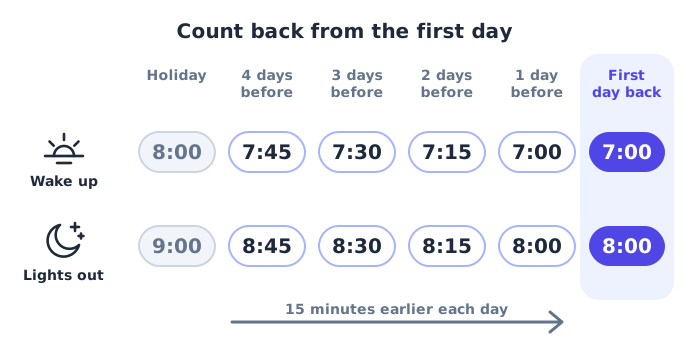
That is the one-hour drift from step 1, at 15 minutes a day: four steps, so the first earlier wake-up is four days before school starts. By the last day of the holiday, both times are school times, and the first morning back is not the first early one.
How many days before the first day back to take the first step:
| Drift | Steps | 15 minutes each day | 15 minutes every 2 to 3 days |
|---|---|---|---|
| 30 minutes | 2 | 2 days before | 3 to 4 days before |
| 1 hour | 4 | 4 days before | 7 to 10 days before |
| 1½ hours | 6 | 6 days before | 11 to 16 days before |
| 2 hours | 8 | 8 days before | 15 to 22 days before |
In each case the last step falls on the last day of the holiday.
Of the two times, the wake-up is the one you control. You can open the curtains and get them up; you can’t make anyone fall asleep. If bedtime slips one night, keep the next wake-up on the plan rather than letting everyone sleep in.
Fitting it around New Year
If school starts again on Monday 4 January 2027 (check your school’s dates), a one-hour drift fits in two ways:
- 15 minutes a day: the steps fall on Thursday 31 December, Friday 1, Saturday 2 and Sunday 3 January. The first step is New Year’s Eve.
- 15 minutes every two days: the steps fall on Monday 28 December, Wednesday 30 December, Friday 1 January and Sunday 3 January. New Year’s Eve is a day in between, when the times stay where they are.
If New Year’s Eve is a late one either way, treat that night as off the plan and pick up again on the 1st. One late night is not the end of the plan; a week of them is what makes the first morning hard.
The morning itself
Sleep times are half of it. The other half is the steps of a school morning, which nobody has done for two weeks.
- The weekend before, find the things that went missing over the break: the lunchbox, the PE kit, the second shoe, the reading folder. Sunday night is too late to find out it’s at a grandparent’s house.
- On the last morning or two of the break, run a school morning for real, at school time: dressed, breakfast, teeth, shoes and coat on, out of the door, even if it’s only round the block. It shows where the morning sticks before it matters.
- Put the steps where everyone can see them. A morning routine chart on the kitchen wall means you point at the next step instead of saying it again. The bedtime routine chart does the same for the evening, which matters this week as much as the morning.
- Allow extra time the first week. Leave ten minutes more than usual for the first few mornings back.
For making a chart that lasts past the first week, see how to make a morning routine chart that works.
On a phone or tablet

ReadySet is one way to do the same thing on an iPhone or iPad: a routine’s steps in order, and a countdown to the routine’s time, on a screen the whole kitchen can see. The routine’s time is a setting you can change, so it can move 15 minutes earlier each day of the run-up along with everyone else. It’s free to try with one routine, and the paper charts work perfectly well without it.