
A morning routine chart for kids: how to make one that works
How to make a morning routine chart your child will actually use: what to put on it, where to stick it and what to do when the novelty wears off.
You already know the list. Get dressed, eat breakfast, brush teeth, find shoes. You know it because you say it out loud every school morning, usually more than once, usually getting louder.
A morning routine chart moves that list off your voice and onto the fridge. It won’t make anyone leap out of bed. What it does is give your child somewhere to look for “what’s next” that isn’t you. Here is how to make one that lasts past the first week.
Start with fewer tasks than you think
Five to seven is plenty. Write down only what has to happen between waking up and walking out of the door. Leave off the things you’d like in an ideal world; making the bed can join once the basics are boring.
If two things always happen together, make them one task. Washing a face and brushing teeth is one trip to the bathroom, so it gets one box.
Put them in the order they really happen
Walk through tomorrow morning in your head, room by room. Bedroom tasks first, then the kitchen, with bag and shoes last because they live by the door. A chart that sends a child back upstairs for socks after breakfast is a chart that makes you late.
Then keep the order the same every day, so nobody has to decide anything at 7:40.
Use pictures and very few words
Two or three words per task, with a picture beside each, so a child who isn’t reading yet can still follow it. “Shoes on” beats “Put your shoes on and wait by the door, please.”
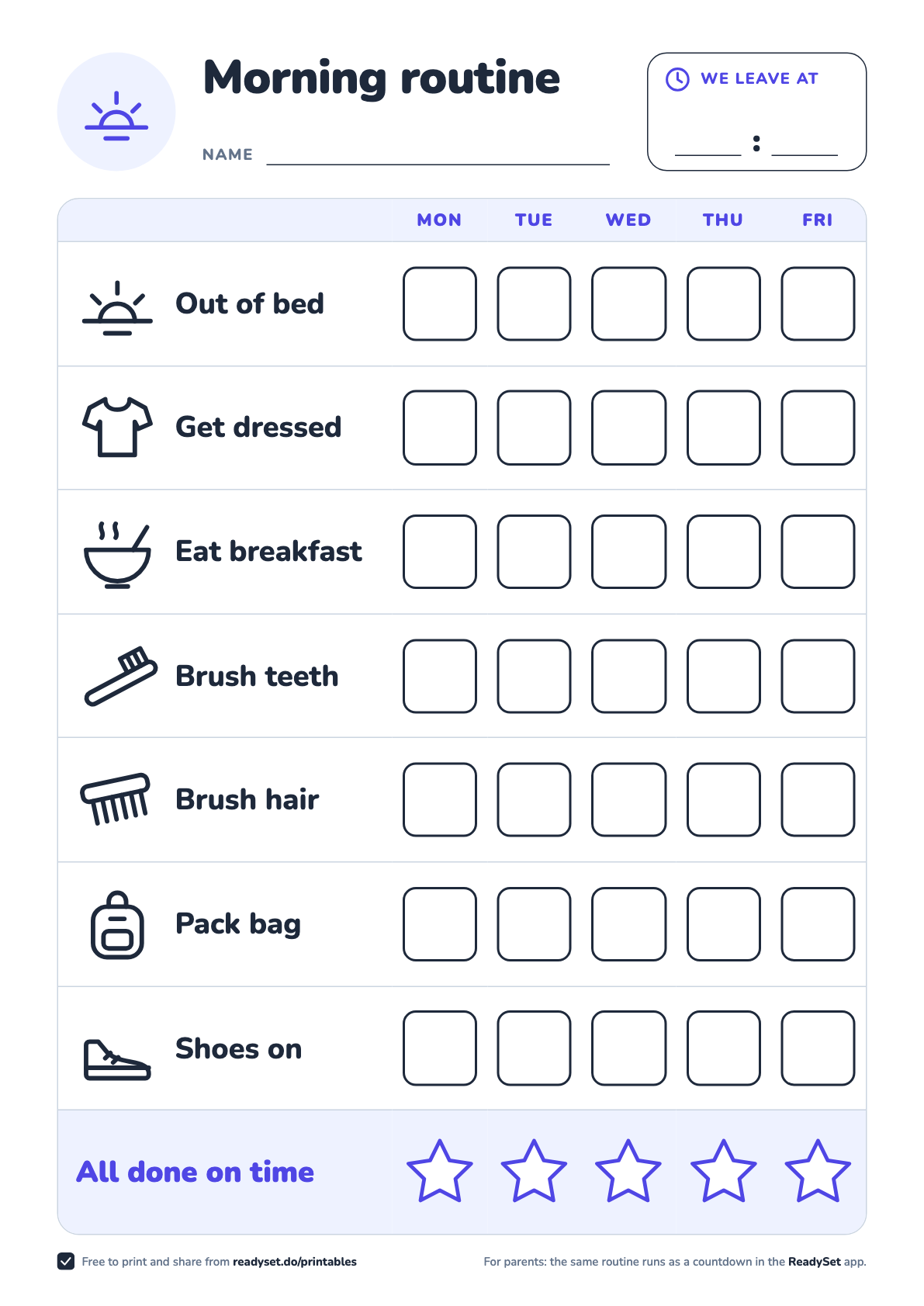
Our free printable morning chart has seven tasks already drawn. If your morning looks different, the blank one has room for your own, with a circle beside each for your child to draw the picture. A chart they helped make is a much easier sell than one that just appeared.
Stick it where the morning happens
At your child’s eye level, not yours. The fridge works if breakfast is the hub; the back of the bedroom door works if getting dressed is where things stall. Tie a pencil to it, or slide the page into a plastic sleeve and use a whiteboard pen so one print lasts for weeks.
Write down when you leave
Most charts say what to do. Few say by when, and “by when” is the part that causes the arguments. Write the time you leave at the top (the printable has a box for it) and put a clock or a kitchen timer where your child can see it.
This changes who the bad guy is. You are no longer the one saying hurry up; the clock is. You get to be the person helping them beat it.
Introduce it on a calm day
Sunday afternoon, not Monday at 7:55. Go through the tasks together and let them choose the pen. Then on Monday, when they ask what to do next, or drift towards the Lego, point at the chart instead of answering. “What’s next on your chart?” is the only line you need.
Let them do the ticking
The tick is the satisfying part, so don’t take it. It will be slower and the ticks will be enormous. A star at the bottom for a morning when everything was done before it was time to leave is a nice extra. A prize for every star gets expensive, and they will negotiate.
When it stops working
It will, a bit, once the novelty goes. That doesn’t mean the chart has failed. Swap a task, move the chart, print a fresh copy, or let your child redesign it on the blank version.
And on the mornings when it all falls apart anyway: skip the star, say nothing clever, and try again tomorrow.
If you’d rather the clock did the talking
A paper chart can’t tell anyone how long is left. That is the part ReadySet does: the same list of tasks with a countdown to the moment you have to leave, on an iPhone or iPad the whole kitchen can see. It’s free to try, and the paper chart works perfectly well without it.
Print the morning chart: A4 PDF or US Letter PDF. There is also a bedtime chart.